I’m revisiting my love of Astronomy and Space, an interest I’ve had as far back as I can remember. It’s been years since I’ve owned my own telescope, and now with my interest rising I’ve reached out to the local Seattle Astronomical Society. As a new member, I attended last weekend’s Star Party held at the Snoqualmie Point Park, about 40 minutes East of Seattle. Star Parties are excellent for meeting others who are interested in Astronomy, and to learn more about Star Gazing and Telescopes. While I’m saving my lunch money for a new telescope of my own, this was a great chance to sort out what would be best for me.�

The park was spectacular, with sweeping views of nearby Mount Si and the Cascade Mountain range. Weather reports were calling for clear skies, although there were some clouds remaining, mixed with smoke from wildfires over the pass. Not quite far enough away from Seattle and the outlying suburbs, a slight glow remained to the East for most of the evening.

This was my first SAS event, so I was expecting to meet a lot of new people. David Ingram was on hand to welcome me, and had already set up his gigantic Dobsonian.

Bob Mulford was there �as well,�with a nicely crafted Dobsonian. I was hoping to see a home-built telescope, having just checked out Richard Berry’s book “Build Your Own Telescope”. Also on hand, Jon Bearscove of the Galileo Astronomy Unclub, Mohammed, Denis, Zong (forgive me, I have no last names here).

As the sun went down, more people arrived and telescopes were set up. David told us all that although this was to be a members-only Star Party, a High School class would be visiting for the first part of the evening as part of the Astronomy Outreach program. The class seemed legitimately interested in spending their Saturday evening under the stars, and they certainly had amazing views through these telescopes.
�
The clouds slowly dissipated, and just as everyone was deliberating whether or not we’d have clear skies, the first stars showed up.

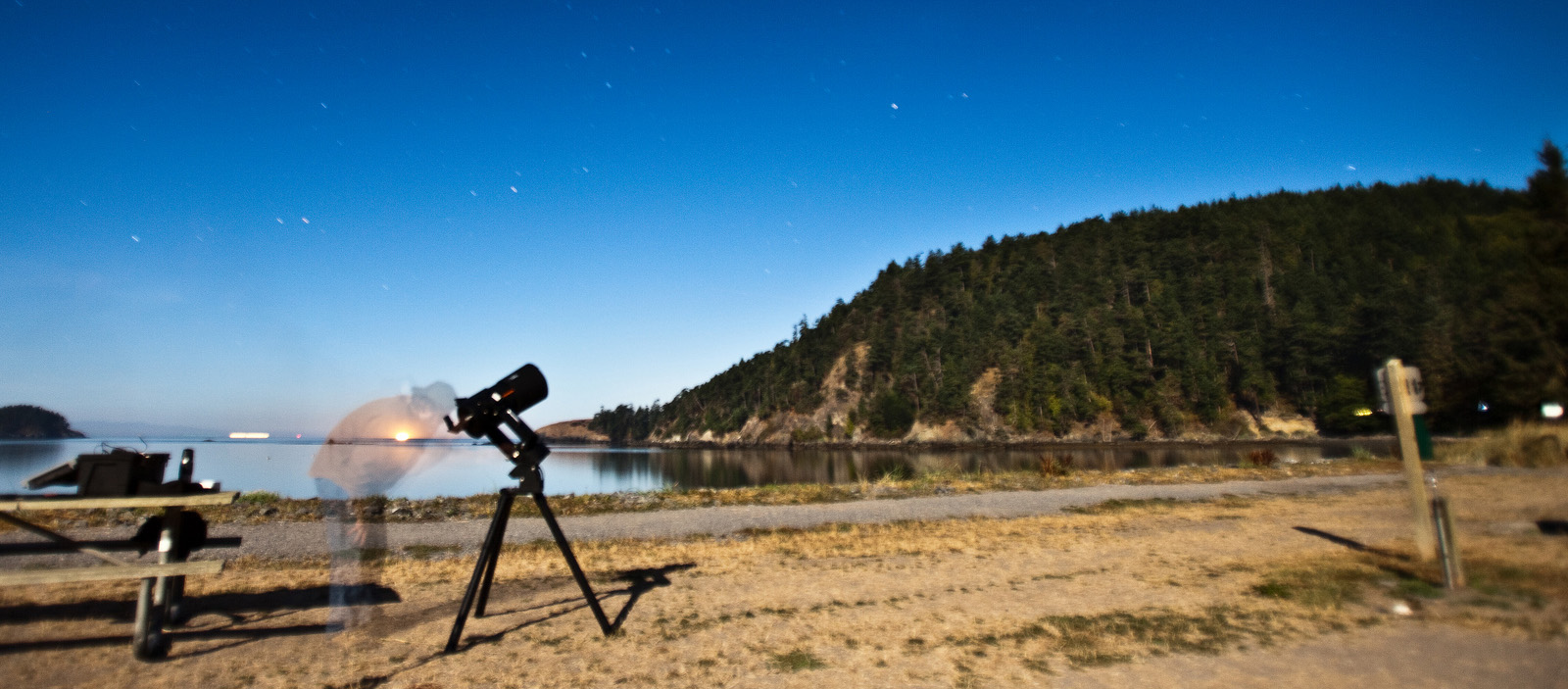
While I don’t have my own telescope, I did bring my digital camera, a Canon 40D, with tripod and two lenses – a 50mm f/1.8 prime lens, and an 11-22mm Wide Angle lens. With clear skies that are darker than what I get in my own backyard, I wanted to try to capture more wide field shots of the skies. This would be perhaps my fifth attempt at star photography, and to be honest I’m still not entirely happy with my own results, but I’m learning a lot each time. Most of the time, I get something that looks like this:

If you click on the full-size version you’ll see that I did indeed capture a lot of stars. Still, it wasn’t nearly as amazing a sight as I was about to witness. Before the High School students arrived from their overview talk nearby, Bob called me over to his telescope “Hey Chris, do you want to see M14, a globular cluster?”
Why yes I would, I thought. The optics on these telescopes were far better than any I’ve owned, better perhaps than any I’ve looked through personally. With a quality eyepiece, it’s like looking out a window on a spaceship. Some have such a wide angle, you do almost feel like you could fall right in. The depth you see is staggering, especially in an object like a globular cluster with many points of light within the same field. Pictures truly do not do it justice, I highly recommend that someday you too seek out a local Astronomy gathering like this. Use someone else’s expensive gear, they’ll be thrilled to show you the sights.
I drifted along to several other setups, and even got my first look through a 2-inch eyepiece. These are much larger than what you would be used to, more like a giant picture-window on a starship. I managed to catch myself on the edge before falling into the double, double-star in the Big Dipper.
[devider type=”” height=”” no_border=””]
My Photos, and the rest of the night
With the students now�queuing�up to see different sights on our now clear skies, I returned to my camera and set about getting as many quality shots of the dark skies as I could. My tripod isn’t equipped to track the stars’ apparent motion, like many of these telescopes, so I had to keep the exposure times low. Andromeda had just moved into the clear, and knowing it’s bright enough that even my camera lenses could pick it up, I decided that would be my target. One of the raw shots even had a tracer from a shooting star:

As I proceeded with taking my shots, behind me I could hear a number of SAS folks calling out the objects they were pointing at – and calling them by their proper names: M31, Albireo the double star, the Coathangar. Clearly I needed to brush up on my Astronomical names, memorize the Messier catalog, and otherwise get back up to speed.
Mostly I managed to get a range of images of the area around Andromeda, enough to where you can actually make out the galaxy. Later, after hours of Photoshop sorcery, you can pull out enough information to get a reasonably decent image. Andromeda is a bright object, one that can be easily seen with any binoculars (or the naked eye on a very clear night, free from any city lights), and can be captured somewhat easily without the aid of a telescope. And while I’m not producing images fit for a coffee-table book, I’m pretty impressed with what you can get from a relatively inexpensive lens and a DSLR. Here’s a closer shot of Andromeda, with very little post-processing.

I have no illusions that my astro-imagesbarely qualify for even rank-amateur status, but it’s a start.

I left a bit before the final hours of the Star Party, but I’m thrilled to have met a lot of really great people and see some amazing sights. The Outreach aspect of the SAS is quite appealing to me. It’s great to see the reactions on people’s faces, the first time they see some of these objects. I’m sure I had the same response myself. I look forward to attending more of these Star Parties, and I certainly encourage you to seek them out in your area. You won’t forget it.