I’ve been trying out a new format for the livestream – daytime streams. It’s allowing more people to drop in and watch, although many admit they’re watching while at work on another monitor. Good for them, and I’m glad to give them a diversion. But I’ve also been trying a new format too. Instead of a painting in a session, I’m working on longer-format paintings. These are larger, and far more finished than the usual painting in a night session.
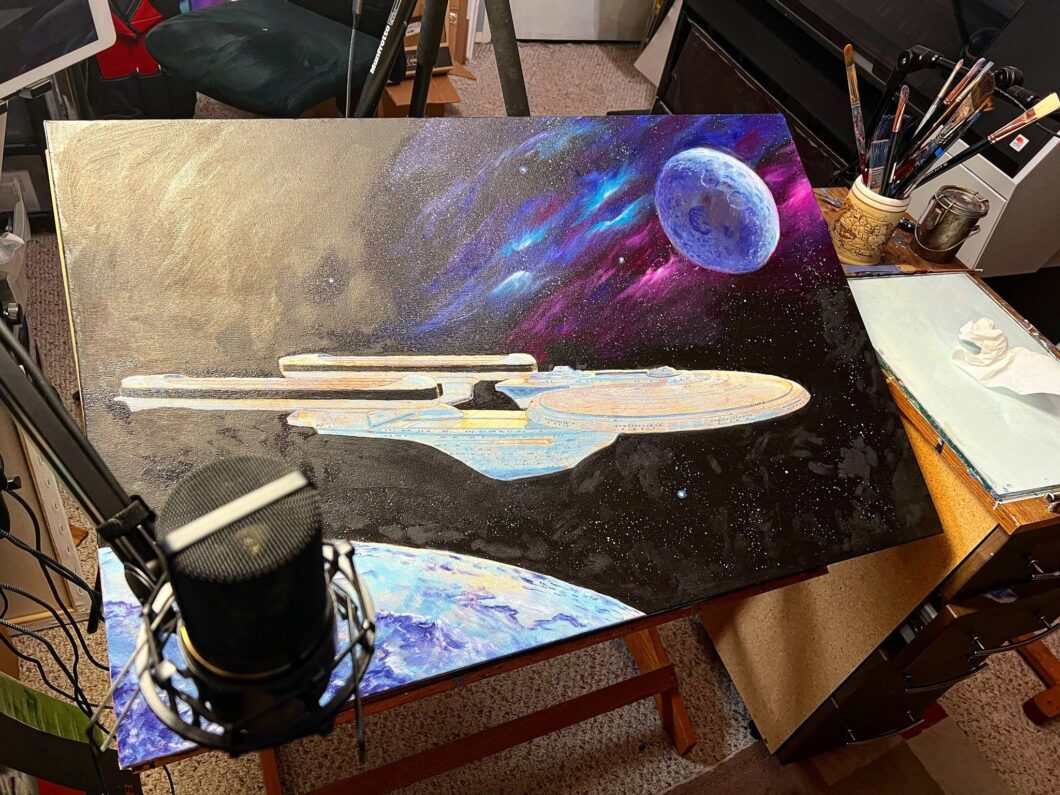
The Voyager painting I’ve previously shared was the first of these. And so far it’s been a great success. The second is this scene of the USS Excelsior. At the same size, 24″ x 36″ it’s a great way to work on the ship detail with a fun scene. This one is in the last stages, so the photo is after my last livestream.
Livestream Progress Shot – Excelsior
While it’s been fun to watch the entire progress live, I find that final details are a bit more consuming and it’s much more efficient for me to work on them alone. Then it allows for a fun reveal live on the show.
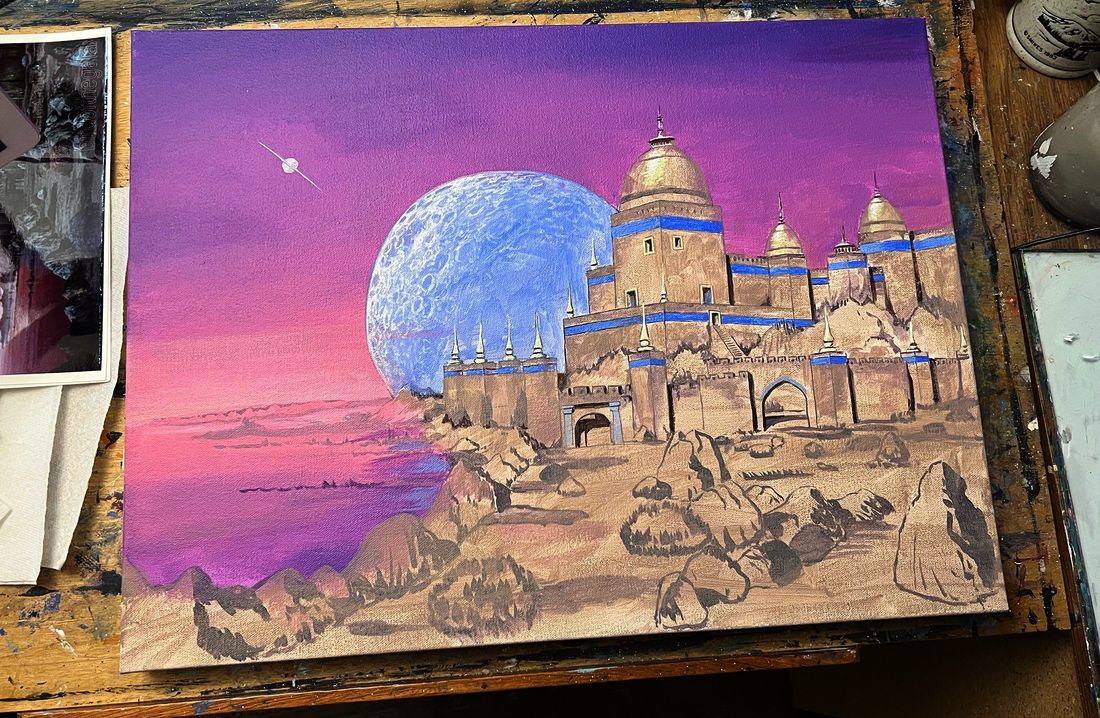
Which brings me to a subject that I’m finally returning to paint, the Rigel 7 Fortress. I’ve been promising a return to this painting for some time. This week I started back in on it and I’ll be working on it live over the next couple of weeks.
Return to Rigel 7
In this photo you see the first stages of the painting. There’s an initial drawing, and then a light layer of shading. The basic color fields were then laid down – sky, planet, building, etc. All of these will need to be detailed and refined. The painting is being made entirely in acrylic (as of this writing that is the plan, but I may switch to oils if necessary).
In short, this is a larger painting than my previous Rigel 7, which is now in the hands of a collector. It’s also a wider crop of the original painting. I received wonderful images from “BirdoftheGalaxy” over on Flickr, and it’s helped me produce a very accurate drawing. The canvas is 20″ x 30″ and roughly the same size (we think) as the original painting. There will be differences of course. The color palette I’ve chosen is closer to what’s seen in the TOS digital remaster. Brighter and more vibrant than some of the original photos. The original was also painted on glass. With my painting there will be a slight texture from the canvas, which is its nature of course. On close inspection of the above image the texture is apparent. But there are many more layers of paint to go before this is finished so I expect it to be less of an issue.
When finished, all of these will be available in the store – both the originals, and limited edition signed prints made in-house. Although the Rigel 7 original painting should be consider on hold until I contact an individual that has first-rights to purchase. If they decline then it will also be available in the store.
Becky Chambers’ new book, and the last of her Hugo Award Winning Wayfarer’s series – The Galaxy and the Ground Within, by HarperCollinsUS. This is the cover art I created for her final book in the series:
The Galaxy And The Ground Within by Becky Chambers
This piece was entirely digital and spans the front and back of the book. I was asked to show a series of spaceships in orbit above a small airless world, the main location of the book. The ships were to look as though they were each from a different species, similar to how Star Trek handles the look of their ships.
Layout and text was handled by Richard Aquan of HarperCollinsUS. My thanks go out to Richard, HarperCollinsUS, and Becky Chambers for the privilege of making the covers for these great books.
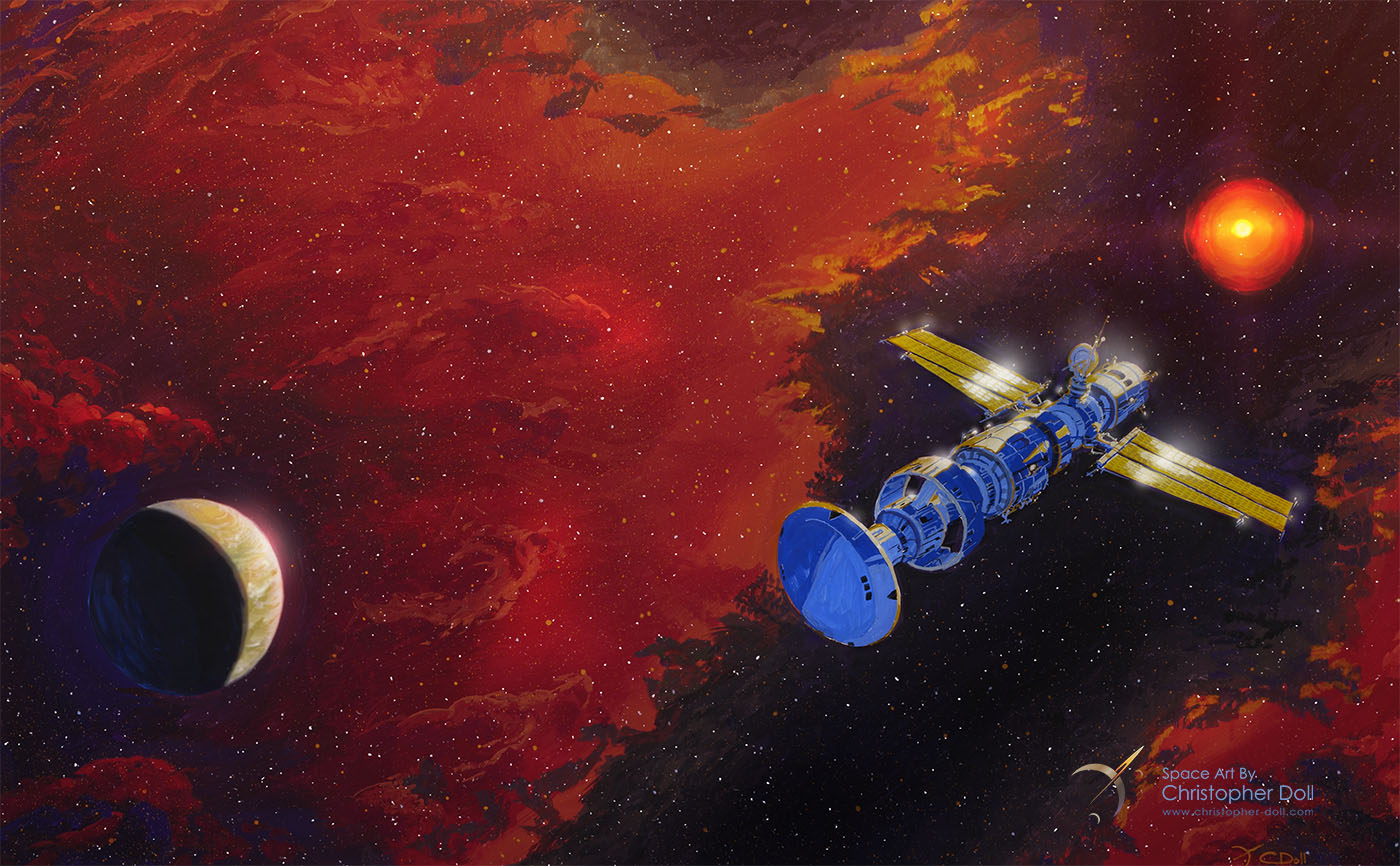
I’ve been working with author Rachel Lulich on this piece for her first book, Random Walk – Book One of the Fractured Galaxy Series. It’s a 30″ x 20″ painting, casein on illustration board with some digital touch-ups in Photoshop.
Random Walk – Full Artwork
This was a fun project that included a fiery red nebula and a near-future NASA-style spacecraft. I wanted to capture a classic, retro-science fiction look with this image.
Here’s the back cover description:
Three Astronauts. One Impossible Journey.
Derek Williams, Jacob Mendez, and Vicky Abrams have trained for years to helm the first manned spaceflight launched by US Air Force Space Command. The Pioneer�s mission is simple � test the experimental new Hawking Engine, designed to take them to Mars faster than any manned craft has travelled before. But when the engine reaches full capacity, the craft unexpectedly hurtles into the unknown.
With power levels falling and communications offline, the crew must face the unbelievable truth � The Pioneer is lightyears from Earth in uncharted space.
Far from the safety of their simulators and support from Ground Control, Derek, Jacob, and Vicky are challenged to the end of their abilities to keep the ship safe � and survive long enough to find a way home.
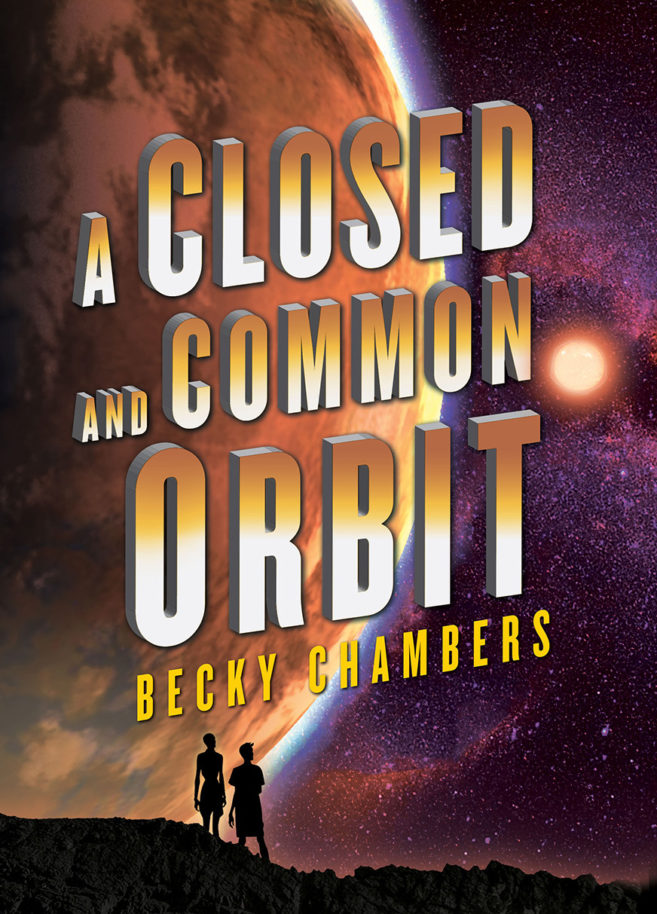
For those of you who enjoyed Becky Chambers’ science fiction novels, I have made prints of the cover art that I made for her and Harper Collins US. They are available in my store, and will be on hand at my upcoming local events.
And my congratulations to Becky Chambers for winning the 2019 Hugo Award for Best Science Fiction Series. I am thrilled to have met her and I wish her the best.
Cover Art Prints for Becky Chambers’ Novels
If you haven’t read her books yet, I highly recommend them – especially if you enjoy science fiction books. She’s done a great job and I am honored to have participated in a small way.
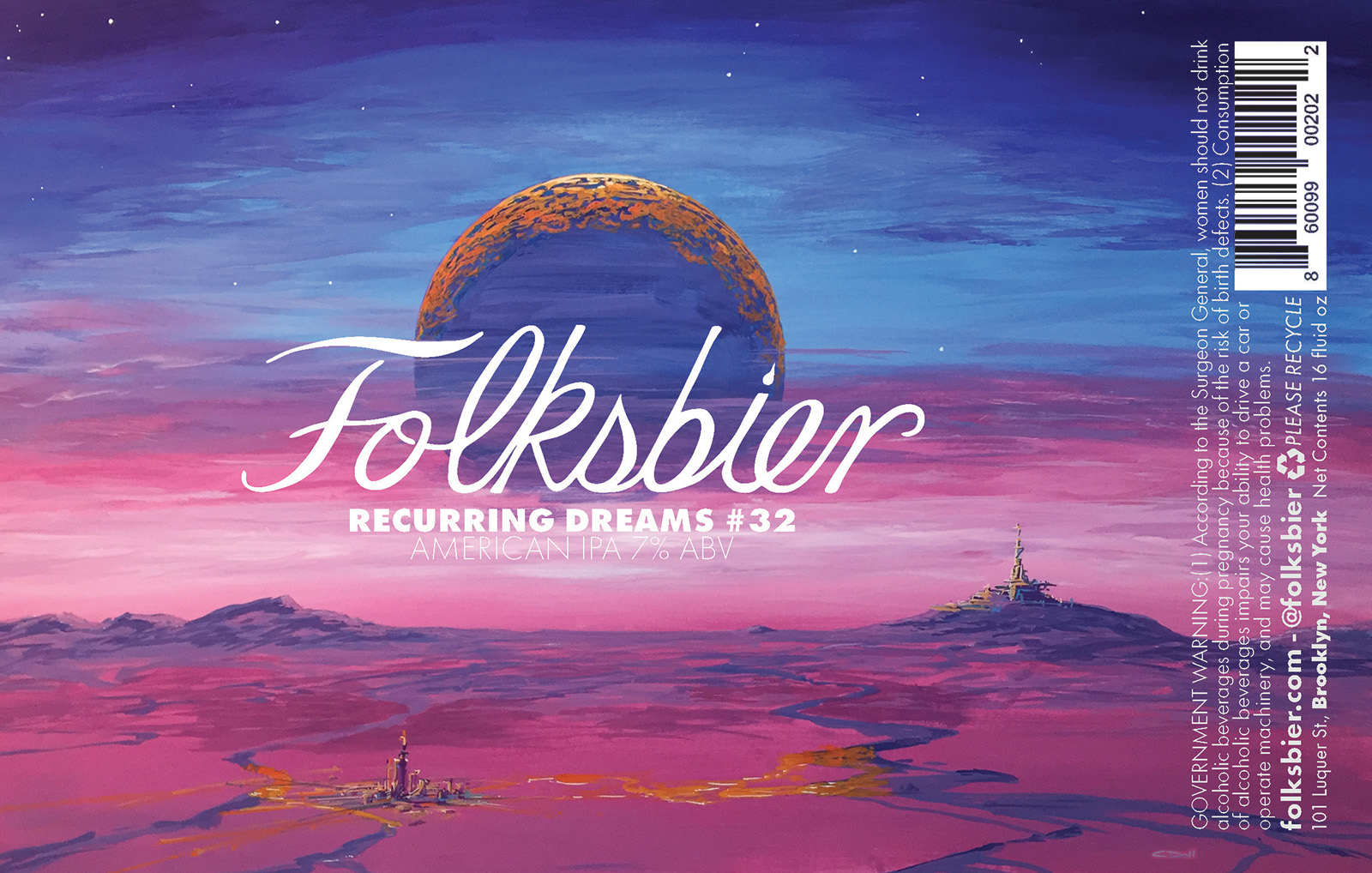
Over on my Youtube Channel I have posted a time-lapse video of me painting Recurring Dreams #32. I’m working on a longer, narrated version that will be available on my soon-to-be-active PATREON page. I will be posting more about my Patreon page soon, but in the meantime here is the timelapse painting:
About the painting
Folksbier Braueri from Brooklyn, NY commissioned this piece for their Recurring Dreams #32 IPA. They wanted a retro science fiction inspiration, in the style of artist Paul Lehr. I was thrilled to paint this scene for them.
They identified a color scheme, a gradient from mauve to deep blue tones with a few stops in between, and several of their favorite Paul Lehr images to get a feel for the style they were looking for. I made a small color sketch and proceeded to paint their scene.
Small color sketch
I used Richeson Casein Paint, which is a water-based paint used by illustrators and artists for many years. It’s fast, like acrylic, and can be painted opaque like guache or thinned for washes like watercolor. It’s very versatile and the colors are bright. Casein was used by many of my favorite artists, and James Gurney (Dinotopia) has some wonderful videos on how to use casein.
Richeson Casein Paint – Titanium White, Permasol Blue, Rose Red, Naples Yellow, Ultramarine Blue, Cerulean Blue
Recurring Dreams #32 is out, as of this writing. So if you’re near Brooklyn, NY drop on by and try out Folksbier Braueri.
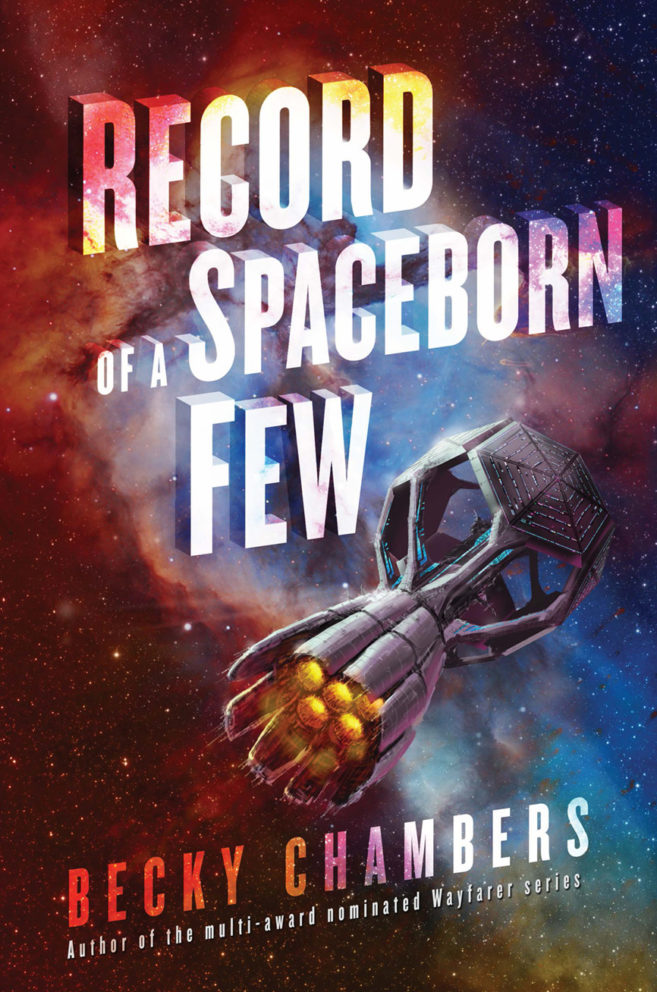
This piece was made digitally. The spaceship, an Exodan Homesteader, was entirely hand-drawn in Photoshop with my Wacom Intuos tablet. These are old colony ships, and have spent hundreds of years in space and have gone through generations of renovations and improvements.
When I was first given the assignment, I had no description of the spacecraft but my art director definitely wanted a spacecraft in a nebula. My first sketches had a totally different spaceship but I was happy with the color scheme. After the first drafts were complete, I received a book excerpt with descriptions of these vast spacecraft, and her own sketches. Becky had even cobbled together a paper model of the ship as she envisioned it.
With all the new information at hand, I went back and re-drew the Exodan Homesteader in similar colors to work with the background.
I highly recommend Becky Chambers’ books. She’s doing fantastic work and I am thrilled to have been a small part of her commercial publications.
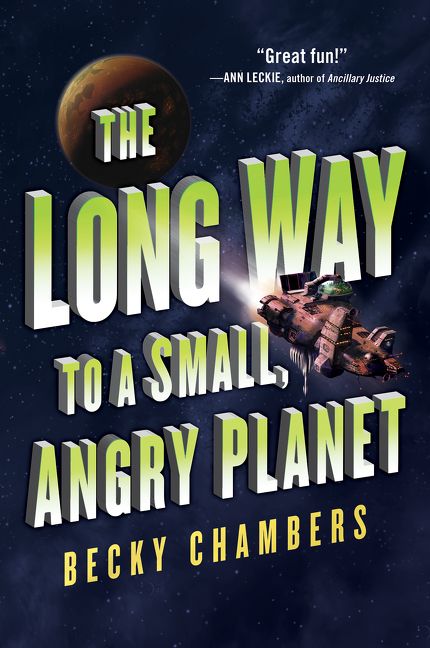
I have previously written about my work on the covers for Long Way to a Small Angry Planet. It has had several iterations before the final US release by HarperCollins.
Five years into a long journey to a distant world, the crew of Stellar Explorer Copernicus detects a radio signal from a nearby star system. Weary from isolation and already far from home, the signal sparks a fiery debate about the nature of their mission, and how to proceed as emissaries of the human race.
The fourth vessel of the Stellar Explorer class, and first to leave our solar system, Copernicus contains over 5,000 capable men and women on a mission to establish an outpost on the first Earth-like world found in a nearby star system . On their journey, they are isolated in an artificial world with almost no contact home for years on end, and no guarantee of return. Their only hope and reward is to find a living, breathing planet where humans can live outdoors. Built by a consortium of corporate and government entities spanning the entire solar system, Copernicus represents nearly a century of mammoth investment and research. Equipped with a powerful Faster Than Light drive, the journey itself is expected to take more than seven years. Each crew member has volunteered decades of their lives on what could be a one-way mission.
To support her crew and mission, Copernicus contains all the necessary equipment and capabilities to build a self-sufficient community on a new world, far away from Earth. Joining them on their journey is a small army of humanoid robots controlled by The Forum, a collection of artificially intelligent entities that help govern their community and Copernicus itself. Maintaining a starship of this size proves far more difficult than imagined. They have faced perilous accidents which claimed the lives of people very close to them. Even with such a large crew, the loss of any one person takes its toll personally and professionally. They can manufacture and repair major components of the ship itself, but people are not easily replaced.
Then out of the silence, a massive radio spike is detected from another star in the local vicinity. It appears to be artificial in origin, and its source is within range of their vessel. Copernicus has the means to investigate the signal, and complete their mission, but by doing so would they would eliminate the possibility of returning home to Earth. The crew must decide whether they should risk their lives and the mission for the chance to meet a possible alien intelligence in a nearby system.
The decision creates havoc among the crew. Many would rather go on to their final destination and leave the signal alone. While most agree that the signal is important enough to risk a detour, especially if it means the possibility of discovering intelligent life nearby, there is great concern for their own well-being and safety. For all it�s impressive capabilities, Copernicus is an unarmed exploration vessel. Many on board insist that they should prepare to defend themselves on the chance that this new species could be malevolent. And for those who wish to meet this new species, as emissaries of the human race, the question arises about how to communicate with beings totally alien to our own experience.
Against all better judgement, I am writing a science fiction novel of my very own. I didn’t want to write a science fiction novel, but a.) an idea stuck with me and wouldn’t leave me alone, b.) I had adequate time to pursue this madness, and c.) it’s guaranteed to have killer cover art.
Landing Operations – Color Comp
I started the first draft last Fall, and I’m calling it Stellar Explorer. That’s merely a project code name for now, I’ve not yet decided on a final title. It’s developed a life of its own, and not merely a shot in the dark, so I’m sharing the details with any of you that are interested.
Where did the idea come from?
In 2015 I was drawing a lot of spaceships, which a number of you followed through my #spaceshipaday Twitter posts. My thanks go out to all of you who have supported my art. Along the way, one particular drawing stuck with me.
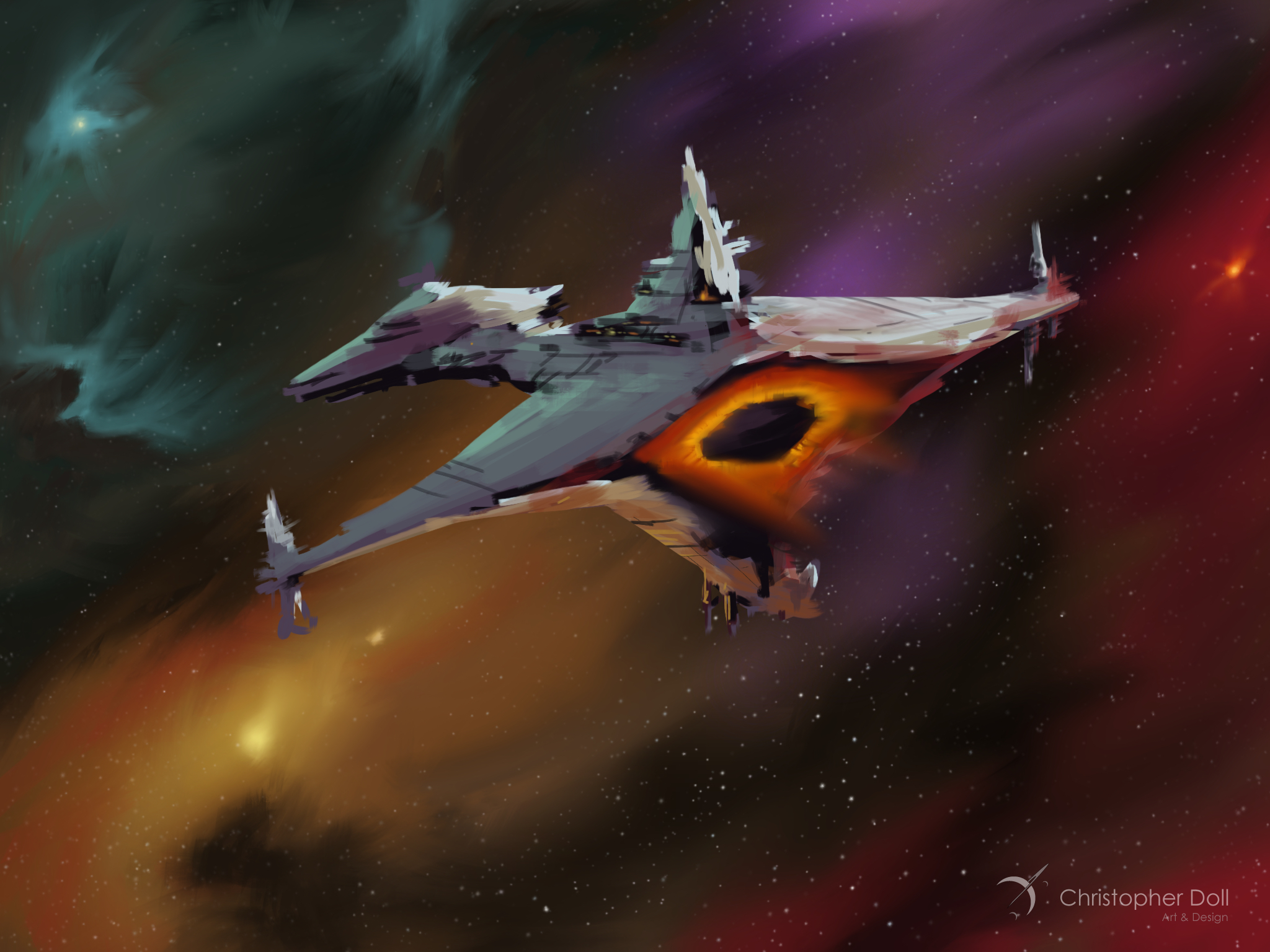
Digital – Procreate on an iPad
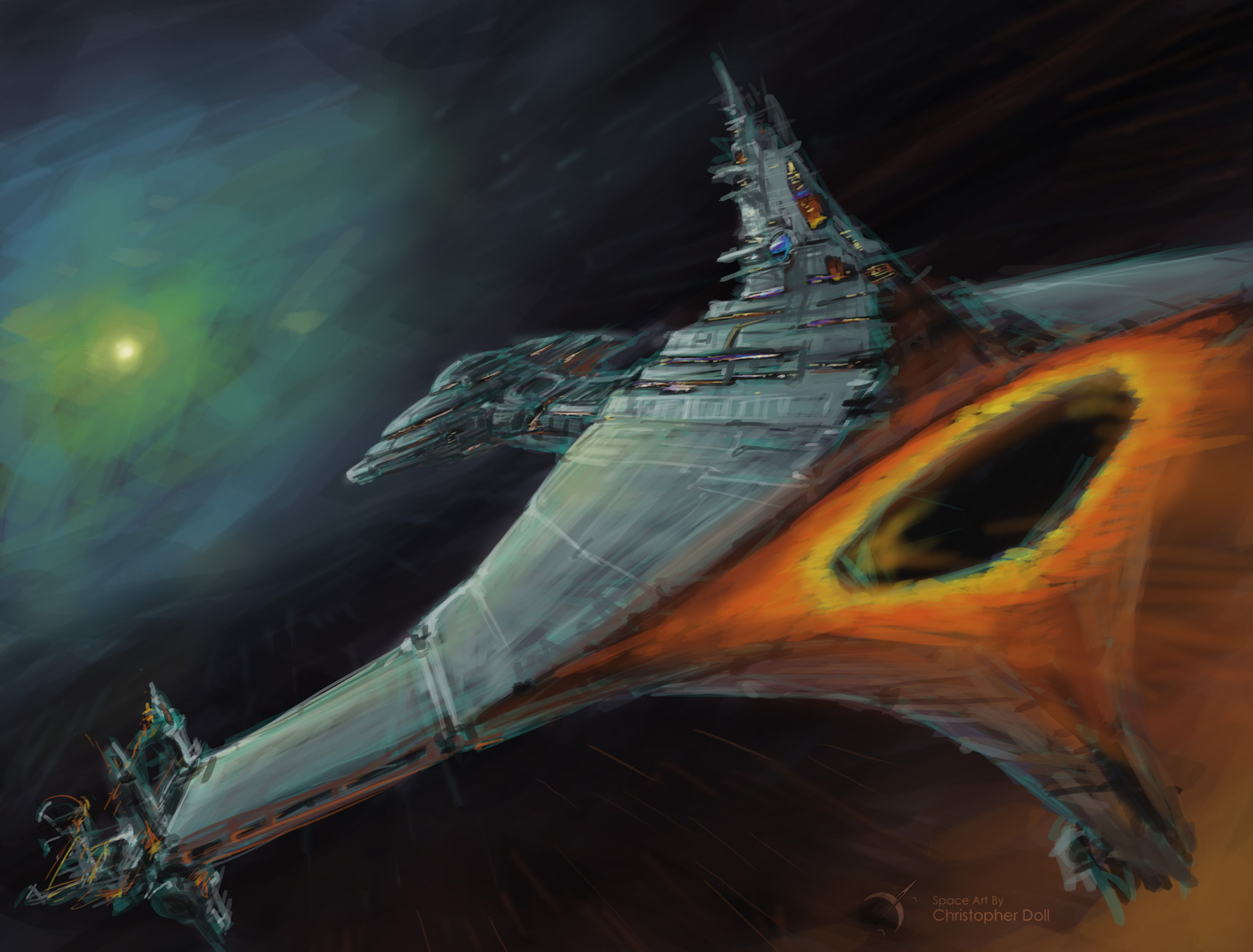
It was a fun drawing that I made on my iPad with the Procreate App. My original intention was to draw a cool background with stars and nebula clouds, but halfway through I felt it was lacking something. It needed a subject, so I added a generic spaceship that was lit with color from the three different star groups, cyan, yellow, and red. The spaceship itself was the fastest part of the whole drawing, and surprised me how it developed so easily. Sketchy in form, with obvious perspective errors, the details flowed fast and fit into place. You know that feeling you get when a plan comes together? That’s what this felt like.
Since I was still on a self-guided mission to improve my artwork, I continued drawing spaceships and fantastic scenes. But this ship stuck with me, and like any other obsession I began to think about that scene. Where was this ship going? Who would build such a ship, and why? What does the rest of it look like? And more importantly, who would live on it?
Digital – Photoshop
Over the next few months, this spaceship kept showing up in my drawings. Those of you following my art posts might have wondered “why is he drawing the same ship over and over again?”. Obsession, of course. This image wouldn’t leave my mind. The other was more practical – I was honing specific drawing skills and in the interest of time it was easier to use a design that I already explored (as opposed to creating a whole new ship). It shows clear lineage to many of the science fiction shows and stories that have inspired me over the years: from Star Trek, Space: 1999, and Star Wars to novels by Larry Niven, Kim Stanley Robinson, James S.A. Corey, and artists like John Berkey, Robert McColl, Vincent DiFate.
After much deliberation and research into contemporary concepts of interstellar travel, it was quite apparent that a spaceship like this is not feasible at all. At least not within the boundaries of existing science and engineering knowledge. It’s enormous, if the size of the windows are any indication. Thousands of people would be able to live inside of it. It would have to reach tremendous speeds to get near those beautiful nebulae within the lifespan of an average human being. And it’s configured like a cruise ship, meaning it would have to have artificial gravity (there are no rotating centrifuges to mimic gravity). But if you extrapolate on a few key technology advancements, technical hand-waving common in the science fiction realm, it starts to look reasonable. At least reasonable enough to warrant further speculation.
What’s it about?
I’ve called the project and this spaceship Stellar Explorer. Derivative perhaps, but as I mentioned earlier the title is TBD. It’s on a long mission to a nearby star where an Earth-like planet was found by observations from our own solar system. To reach this star system, a consortium of business and government agencies invested in a massive program to build a starship that would allow humans to go to this new world and begin exploring it in person, a first step towards a much larger colonization effort.
My story is about the crew of this Stellar Explorer, and their journey to set foot on a new Earth in another star system. They are a capable group, hand picked for their resilience, skill, and willingness to renounce family, country and friends, giving up years of their lives on a mission of exploration.
In this future history, humans have already set up colonies on the Moon, Mars, in orbit around Venus, and several moons of Jupiter and Saturn. We’ve become very good at setting up artificial environments, but they are expensive and exist mainly to harvest the rich resources necessary to sustain the exploding population on Earth. Little mining is conducted on Earth anymore, in an effort to rescue the collapsing ecosystems there after centuries of abuse at the hands of industrialists and modern warfare.
Interior Sketch – Main Arboretum
Living off-world in artificial environments isn’t pleasant for the working population. It’s claustrophobic, even in the larger domed cities, and it’s dangerous as even a small accident can kill large numbers of people (and have over the course of this future history). There is a thriving leisure travel industry that promotes exotic cruises to locations throughout the solar system, although only the very rich can afford such luxuries. In spite of our expansion into the system, the most sought-after, expensive properties are the few remaining open spaces left on Earth. Places where you can walk and live outdoors.
Close rendezvous with an asteroid.
The discovery of an Earth like planet in a nearby star star system sets off a 100 year race to build and test the technology necessary to get humans there and become a true interstellar species. Many worlds had already been discovered using astronomy observations, but the catalyst was the first actual image of a blue world. Seeing another living planet for the first time inspired all of the human race. It would be a new home where people could live in the open, free of artificial spaces and the threat of ecological collapse. And real estate there would be outrageously expensive.
That’s all fine, but it sounds like every other science fiction story. What makes yours so different?
The best science fiction I’ve read doesn’t focus entirely on cool technology and spaceships, although that’s often part of the mix. It focuses on us, the people who are living and breathing (and reading) today. Filling a novel with spaceships and rayguns is fun but for me the more interesting part is the human story.
Concept Sketch – Status Report
What happens to a group of people who are stuck inside of a large spaceship on a journey that will take years? What do you do to pass the time? Who goes crazy from the monotony? What happens when you break up with someone, and you still have to live near them? Even though this Stellar Explorer is big, and carries tremendous exploration capabilities at the new world, it is an isolated island of humanity on a long, lonely voyage. Think about a large, luxurious ocean liner. For a week or two it’s fantastic. You have great food, entertainment at your fingertips, exercise facilities, lots of booze, and exotic destinations. But if you were on that same cruise ship for six to ten years, with the same group of people, it would start to drive you nuts.
Character Sketch – Tarika Donnelly
Perhaps a better analogy for this Stellar Explorer are the science stations in Antarctica. In fact, there’s a great documentary called Antarctica which I watched while thinking through all of this. I highly recommend it. The people living at McMurdo station live in artificial communities in a part of the world that can kill you outright if you’re not properly prepared. They are isolated and most rotate out after six months, although a number of people have committed themselves to year-round living. They become a microcosm of humanity, working day to day in a place that is beautiful and deadly with little outside assistance or contact.
What makes you think you can write a good science fiction novel?
Honestly I don’t know if I can write a good science fiction novel. It may be a complete disaster with a cool cover. I have no illusions that writing is easy. It isn’t. I may only be good at building the world and drawing it, I don’t know. But as they say “write what you know”, and I know science fiction. I also know a hell of a lot about the dysfunction of professional organizations and being trapped in high tech environments with people that you either want to hug or strangle, take your pick. Somehow there’s a connection, and one that I think will be worth exploring.
My only published work at the moment is a coloring book, with more on the way. I’ve tried my hand at writing many times, and some of the first were on a typewriter (kids, ask your parents what these were). Short stories, film scripts, novels, I’ve collected a number of them over the years and while I admit that most of them weren’t finished, and none of them published, a few of them weren’t half bad based on the comments from the few who read them.
The first degree I studied in college was film production. It was a small program in a community college but you did need to think about your stories and it inspired me to begin looking at the craft of writing. At the time I struggled with it. I was young, admittedly inexperienced, and it showed in my stories. I understood the mechanics of writing, but fell short on capturing life. I set it aside many times and would occasionally get inspired to write science fiction.
Nothing I’ve tried writing has had the same depth and momentum as this Stellar Explorer idea, and I hope that over the next year or so you will find it interesting enough to stick around with me while it comes together.
A Stellar Explorer closes in on a moon orbiting a gas giant
What’s the status of this novel, and what’s next?
I’ve already completed a good portion of the first draft. It’s been a learning experience for me as it is the most ambitious writing project I’ve undertaken. I knew going in that writing a novel is a lot of work, and nothing I’ve learned so far has proven me wrong. After I finish the first draft there will be a number of edit passes before it’s ready for publication.
At this time I have no publisher, this is entirely a project of my own creation. There are a lot of self-publishing routes available to me, and there’s still plenty of time to make that determination when I get closer to being done.
I intend to begin introducing the characters and the world to you all as I progress. I hope you come along for the ride and enjoy the journey as much as I have so far. Cheers