I am thrilled to announce my new line of scale model planets, starting with Saturn!
Each Saturn is 11″ in diameter, and the planet’s body is 4.5″. They are made from clear acrylic, and each is hand-painted.
Pre-Order Now!
Both the standard sized Saturn and the smaller ornament are now up for pre-order in my store. These are all made by hand, and can take up to two weeks for delivery in the Continental US.
COMING SOON
The rest of the Solar System planets (including Pluto, regardless of its classification on the day you are reading this), are going to be available soon as well.
You may have noticed a number of new watercolor paintings lately. Why all of a sudden have I moved to a new medium? Partly, it’s from the portability. Last summer I picked up a great little travel watercolor kit from Windsor Newton’s Cotman line. The kit fit nicely into my travel bag and I brought it with me regularly to the Doll House Baked Goods’ Farmers Markets.
I started painting some of my #spaceshipaday drawings while hanging out at the markets. One of the images was used for the cover of my Coloring Book, Coloring Space 1. I liked the simplicity and speed. And the Windsor Newton Cotman Watercolors were a lot better than I expected.
Once I got the hang of the basics, as with any paint media, I started trying out a few other subjects including some of my favorite lighthouses and scenes. Not only is watercolor a fast media to use, it’s quite unforgiving. That forces you to commit to your painting faster than usual. It’s a good exercise and with the right touch they can look fantastic.
Cape Disappointment and Starry Sky
Night Sky – Original Watercolor 4″ x 6″
North Head Lighthouse
HMS Surprise Ambushed By The Acheron
Pioneer Building, Seattle, Washington
I am by no means a master at this, and I don’t claim to be. This is merely another chance for me to explore color in my artwork. As much as I enjoy the digital experience with my iPad, Procreate, and a stylus, there’s something more visceral and rewarding about working with traditional tools.
Artist Travel Kit
These sketches were fun but I was finding that I wanted a few more options during some of the longer market sessions. Then we packed for a long RV trip to Michigan and I wanted to bring some of my paint supplies with me.� I was limited to a few pens, pencils and smaller 4″ x 6″ cut sheets of watercolor paper – my basic drawing package that I bring with me almost everywhere. But back home I had a lot more tools and supplies that I often used in my studio. To get things a bit more portable I started gathering my essentials into a larger kit.
Wine Box To The Rescue
I started with a fine wooden box from Chateau Ste. Michelle, a perfect size for my kit. It would be a bit larger than a sling-bag but it gave me a few more options while on location.
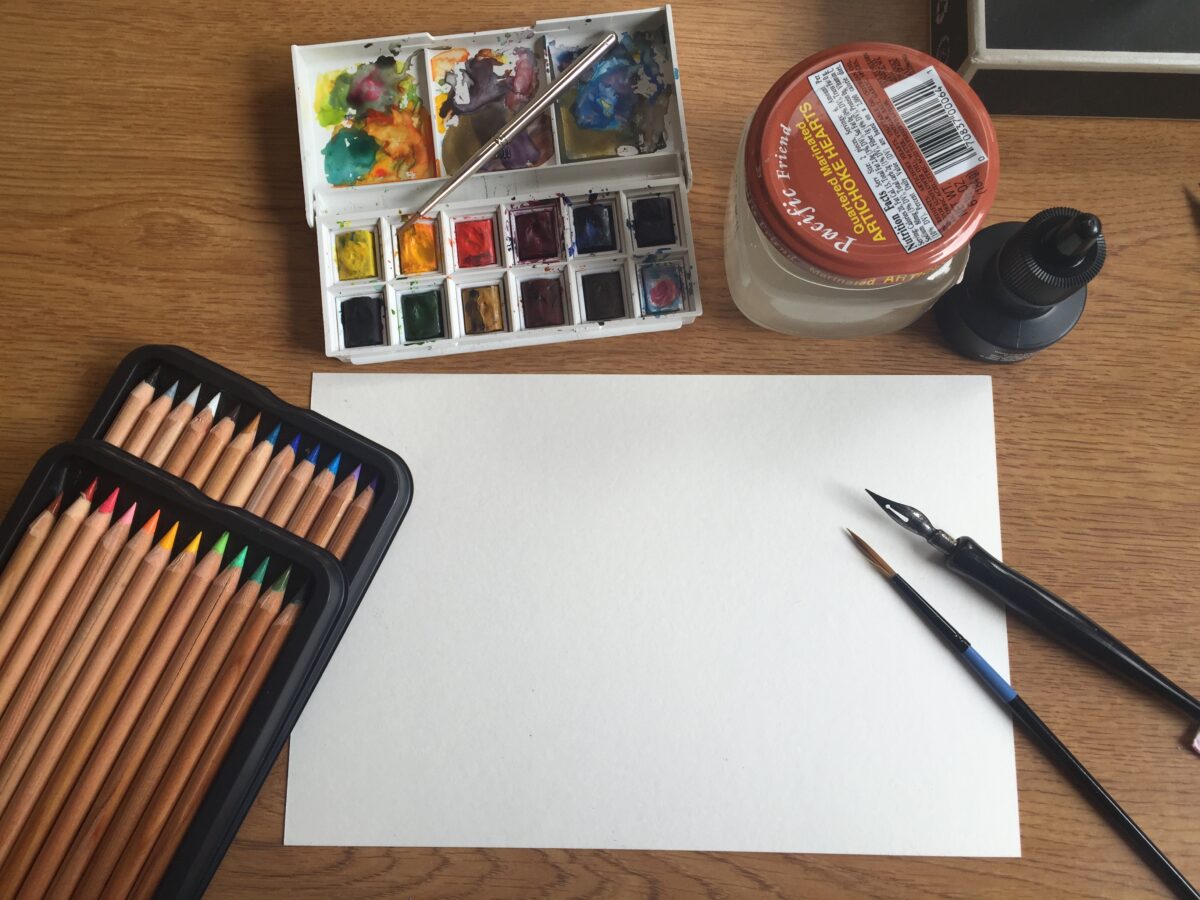
Now I have a bigger container of pens, including my ink-well style pens from ages ago when I drew my cartoons by hand. They still work very well. I also have a small Prismacolor Colored Pencil set, a new box of Pentel watercolors that I’m just starting to try out, my old design pastels, Golden liquid acrylic paints, a jar for water, erasers, and several pencil sharpeners. It all fits nicely in the box and it even leaves enough room for a wider variety of watercolor paper sizes.
My Travel Art Kit
The Kit
Portability Achievement Unlocked
Sure it’s a bit more to carry than my sling bag, but it also acts as its own tabletop when I don’t have a lot of flat surfaces. Later I’ll figure out an option for mounting a tripod and maybe re-work the lid into a drawing table with optional angles, who knows. The existing hinges are more decorative and won’t hold up well� with repeated heavy usage.
I’m looking forward to doing a lot more of these, especially once we open our new shop. There I’ll have the room to work on paintings in the public full-time.
Now Available In My Store
A number of these are already available for sale in my store. I’m offering the originals right now and will be offering prints once I decide on a proper avenue for producing them. As much as I hate to turn this into a giant sales pitch, the purchases do help me continue making these. Thank you all
Against all better judgement, I am writing a science fiction novel of my very own. I didn’t want to write a science fiction novel, but a.) an idea stuck with me and wouldn’t leave me alone, b.) I had adequate time to pursue this madness, and c.) it’s guaranteed to have killer cover art.
Landing Operations – Color Comp
I started the first draft last Fall, and I’m calling it Stellar Explorer. That’s merely a project code name for now, I’ve not yet decided on a final title. It’s developed a life of its own, and not merely a shot in the dark, so I’m sharing the details with any of you that are interested.
Where did the idea come from?
In 2015 I was drawing a lot of spaceships, which a number of you followed through my #spaceshipaday Twitter posts. My thanks go out to all of you who have supported my art. Along the way, one particular drawing stuck with me.
Digital – Procreate on an iPad
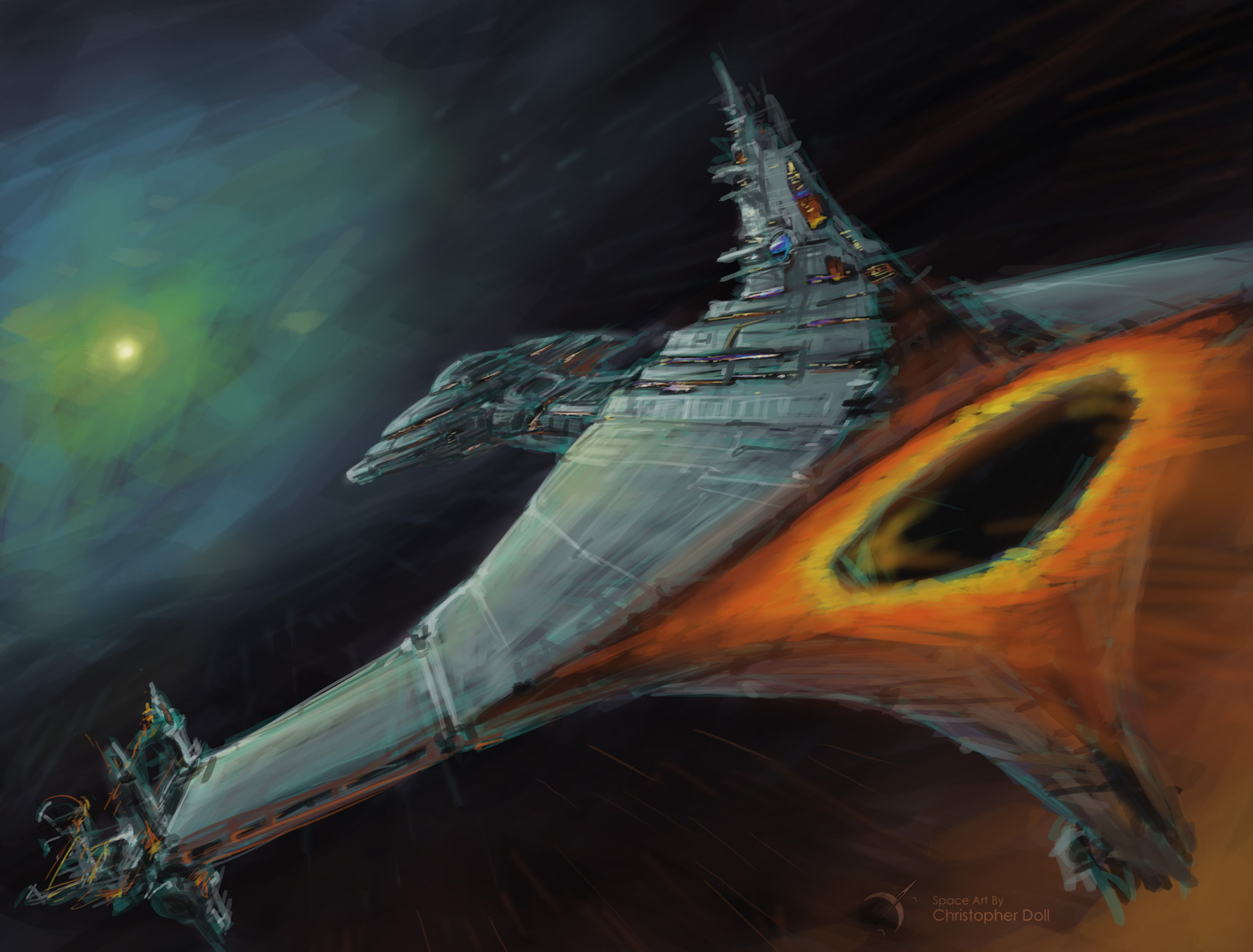
It was a fun drawing that I made on my iPad with the Procreate App. My original intention was to draw a cool background with stars and nebula clouds, but halfway through I felt it was lacking something. It needed a subject, so I added a generic spaceship that was lit with color from the three different star groups, cyan, yellow, and red. The spaceship itself was the fastest part of the whole drawing, and surprised me how it developed so easily. Sketchy in form, with obvious perspective errors, the details flowed fast and fit into place. You know that feeling you get when a plan comes together? That’s what this felt like.
Since I was still on a self-guided mission to improve my artwork, I continued drawing spaceships and fantastic scenes. But this ship stuck with me, and like any other obsession I began to think about that scene. Where was this ship going? Who would build such a ship, and why? What does the rest of it look like? And more importantly, who would live on it?
Digital – Photoshop
Over the next few months, this spaceship kept showing up in my drawings. Those of you following my art posts might have wondered “why is he drawing the same ship over and over again?”. Obsession, of course. This image wouldn’t leave my mind. The other was more practical – I was honing specific drawing skills and in the interest of time it was easier to use a design that I already explored (as opposed to creating a whole new ship). It shows clear lineage to many of the science fiction shows and stories that have inspired me over the years: from Star Trek, Space: 1999, and Star Wars to novels by Larry Niven, Kim Stanley Robinson, James S.A. Corey, and artists like John Berkey, Robert McColl, Vincent DiFate.
After much deliberation and research into contemporary concepts of interstellar travel, it was quite apparent that a spaceship like this is not feasible at all. At least not within the boundaries of existing science and engineering knowledge. It’s enormous, if the size of the windows are any indication. Thousands of people would be able to live inside of it. It would have to reach tremendous speeds to get near those beautiful nebulae within the lifespan of an average human being. And it’s configured like a cruise ship, meaning it would have to have artificial gravity (there are no rotating centrifuges to mimic gravity). But if you extrapolate on a few key technology advancements, technical hand-waving common in the science fiction realm, it starts to look reasonable. At least reasonable enough to warrant further speculation.
What’s it about?
I’ve called the project and this spaceship Stellar Explorer. Derivative perhaps, but as I mentioned earlier the title is TBD. It’s on a long mission to a nearby star where an Earth-like planet was found by observations from our own solar system. To reach this star system, a consortium of business and government agencies invested in a massive program to build a starship that would allow humans to go to this new world and begin exploring it in person, a first step towards a much larger colonization effort.
My story is about the crew of this Stellar Explorer, and their journey to set foot on a new Earth in another star system. They are a capable group, hand picked for their resilience, skill, and willingness to renounce family, country and friends, giving up years of their lives on a mission of exploration.
In this future history, humans have already set up colonies on the Moon, Mars, in orbit around Venus, and several moons of Jupiter and Saturn. We’ve become very good at setting up artificial environments, but they are expensive and exist mainly to harvest the rich resources necessary to sustain the exploding population on Earth. Little mining is conducted on Earth anymore, in an effort to rescue the collapsing ecosystems there after centuries of abuse at the hands of industrialists and modern warfare.
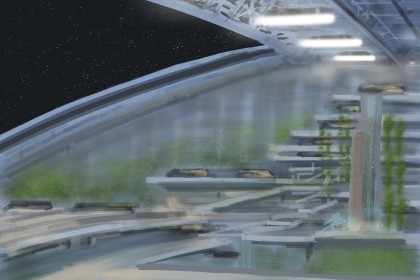
Interior Sketch – Main Arboretum
Living off-world in artificial environments isn’t pleasant for the working population. It’s claustrophobic, even in the larger domed cities, and it’s dangerous as even a small accident can kill large numbers of people (and have over the course of this future history). There is a thriving leisure travel industry that promotes exotic cruises to locations throughout the solar system, although only the very rich can afford such luxuries. In spite of our expansion into the system, the most sought-after, expensive properties are the few remaining open spaces left on Earth. Places where you can walk and live outdoors.
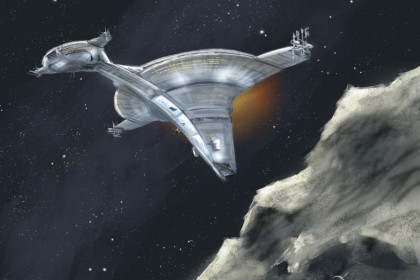
Close rendezvous with an asteroid.
The discovery of an Earth like planet in a nearby star star system sets off a 100 year race to build and test the technology necessary to get humans there and become a true interstellar species. Many worlds had already been discovered using astronomy observations, but the catalyst was the first actual image of a blue world. Seeing another living planet for the first time inspired all of the human race. It would be a new home where people could live in the open, free of artificial spaces and the threat of ecological collapse. And real estate there would be outrageously expensive.
That’s all fine, but it sounds like every other science fiction story. What makes yours so different?
The best science fiction I’ve read doesn’t focus entirely on cool technology and spaceships, although that’s often part of the mix. It focuses on us, the people who are living and breathing (and reading) today. Filling a novel with spaceships and rayguns is fun but for me the more interesting part is the human story.
Concept Sketch – Status Report
What happens to a group of people who are stuck inside of a large spaceship on a journey that will take years? What do you do to pass the time? Who goes crazy from the monotony? What happens when you break up with someone, and you still have to live near them? Even though this Stellar Explorer is big, and carries tremendous exploration capabilities at the new world, it is an isolated island of humanity on a long, lonely voyage. Think about a large, luxurious ocean liner. For a week or two it’s fantastic. You have great food, entertainment at your fingertips, exercise facilities, lots of booze, and exotic destinations. But if you were on that same cruise ship for six to ten years, with the same group of people, it would start to drive you nuts.
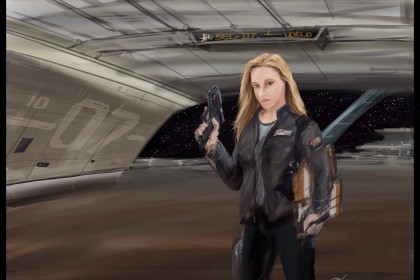
Character Sketch – Tarika Donnelly
Perhaps a better analogy for this Stellar Explorer are the science stations in Antarctica. In fact, there’s a great documentary called Antarctica which I watched while thinking through all of this. I highly recommend it. The people living at McMurdo station live in artificial communities in a part of the world that can kill you outright if you’re not properly prepared. They are isolated and most rotate out after six months, although a number of people have committed themselves to year-round living. They become a microcosm of humanity, working day to day in a place that is beautiful and deadly with little outside assistance or contact.
What makes you think you can write a good science fiction novel?
Honestly I don’t know if I can write a good science fiction novel. It may be a complete disaster with a cool cover. I have no illusions that writing is easy. It isn’t. I may only be good at building the world and drawing it, I don’t know. But as they say “write what you know”, and I know science fiction. I also know a hell of a lot about the dysfunction of professional organizations and being trapped in high tech environments with people that you either want to hug or strangle, take your pick. Somehow there’s a connection, and one that I think will be worth exploring.
My only published work at the moment is a coloring book, with more on the way. I’ve tried my hand at writing many times, and some of the first were on a typewriter (kids, ask your parents what these were). Short stories, film scripts, novels, I’ve collected a number of them over the years and while I admit that most of them weren’t finished, and none of them published, a few of them weren’t half bad based on the comments from the few who read them.
The first degree I studied in college was film production. It was a small program in a community college but you did need to think about your stories and it inspired me to begin looking at the craft of writing. At the time I struggled with it. I was young, admittedly inexperienced, and it showed in my stories. I understood the mechanics of writing, but fell short on capturing life. I set it aside many times and would occasionally get inspired to write science fiction.
Nothing I’ve tried writing has had the same depth and momentum as this Stellar Explorer idea, and I hope that over the next year or so you will find it interesting enough to stick around with me while it comes together.
A Stellar Explorer closes in on a moon orbiting a gas giant
What’s the status of this novel, and what’s next?
I’ve already completed a good portion of the first draft. It’s been a learning experience for me as it is the most ambitious writing project I’ve undertaken. I knew going in that writing a novel is a lot of work, and nothing I’ve learned so far has proven me wrong. After I finish the first draft there will be a number of edit passes before it’s ready for publication.
At this time I have no publisher, this is entirely a project of my own creation. There are a lot of self-publishing routes available to me, and there’s still plenty of time to make that determination when I get closer to being done.
I intend to begin introducing the characters and the world to you all as I progress. I hope you come along for the ride and enjoy the journey as much as I have so far. Cheers
Winding into Fall of 2015, I have been taking my design sketches into more finished pieces. As fun as it’s been creating my #spaceshipaday entries, it’s clear that I also need to demonstrate more finished work like the ones I’m showing here. I set out with several goals for these drawings:
Draw something that would make me want to read this book (clearly from a science fiction aspect)
Tighten up details from my original sketches, while embracing my somewhat chaotic style
Practice more subtle use of color tones (often my color work stays a bit too saturated).
The first two pieces started out as #spaceshipaday line and marker drawings that garnered a lot of compliments and attention through Twitter, Instagram, and on Facebook. My thanks to you all who’ve been following along. I appreciate the comments and compliments I’ve received so far.
Original Sketch for the John Berkey styled ship
Color pass and extra detail using Photoshop and a Wacom Intuos Stylus
Clearly influenced by my love of John Berkey’s artwork, I wanted to draw something that had the same amount of crazy and wonderful details as his work. Since I’ve time-boxed my initial sketches (45 minutes or less), it’s actually tricky to get in a lot of detail especially if you’re trying to make it fit in some fashion with the rest of the ship. Overall I was happy with the concept, although some pointed out that it’s starting to look like the spaceship from the Coneheads movie, or maybe even Colonial One from Battlestar Galactica (the new show). Influences aside, my focus was more on the process.
The sketch was photographed and taken into Photoshop where I gave it a quick color pass (above). As of this writing, it is still unfinished, I’ll post the final in my Gallery.
Heavy Transport in a deep atmosphere. Rendered with Procreate on an iPad
This next image was also quite popular as a sketch, this time I stepped more into Chris Foss territory. I tried to leave the atmosphere fairly bland compared to the ship itself, although looking at it now I think it could be even more diffused. I realize I’ve left in many of the lines from my original sketch. To me this is still one stage away from being a final cover art piece and my focus has been on trying to achieve an emotional impact with the design and rendering.
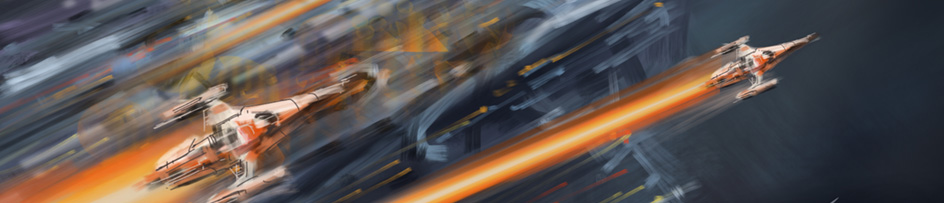
Speed Chase – no sketch, entirely drawn with Procreate on an iPad
Finally there’s this fun piece that was created entirely in Procreate on my iPad. There was no sketch. Sometimes everything comes together all at once and it all becomes a joy to witness. This is one of those moments where I just let my hand run free with only my artistic lizard brain at the controls. I don’t know of any other way to describe it but everything from the color, composition, and the frenzied style seemed to fit together nicely without a lot of effort. I would be inclined to read this book if I saw it in the store.
This week I was featured on the Amazing Stories website in a series that profiles Space Artists, members of the IAAA (International Association of Astronomical Artists). I’m honored and privileged to have been selected for this article alongside artists that I’ve looked up to over the years. If you get a chance, check it out: